











Ocean researcher brings audience under the surface to learn about the deep sea
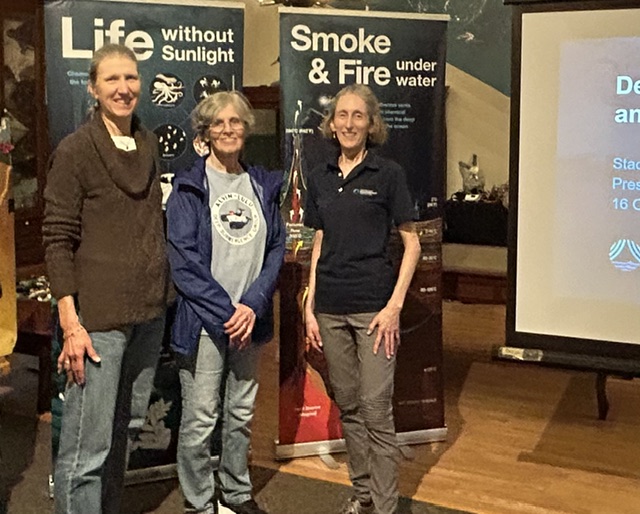 Stace Beaulieu, right, spoke at the Marion Institute on Oct. 16. Photo source: Eileen Marum
MARION — Researcher Stace Beaulieu brought her audience beneath the waves to learn about deep-sea exploration, life around hydrothermal vents and her adventures aboard research submersible Alvin.
She spoke about her research career to a full house at the Marion Natural History Museum on Oct. 16.
Beaulieu’s interest in the ocean began when she was young. She grew up near the sea and began snorkeling at about 6 years old. She knew she wanted to become a deep-sea biologist and went on to earn her Ph.D from the University of California, San Diego.
She has spent nearly 27 years working at the Woods Hole Oceanographic Institution exploring the sea. Her research focuses on the biodiversity and distribution of marine life, particularly invertebrates living on the deep seafloor and their larvae.
She also developed a database documenting locations worldwide where hydrothermal vents have been discovered.
Submersible Alvin, a titanium sphere launched from research vessel Atlantis, helps Beaulieu collect samples and observe underwater creatures. She said the adventure continues long after a dive ends, as sorting samples and discovering an unfamiliar organism can be just as thrilling as exploring the seafloor itself.
Her talk also explained how hydrothermal vents work. These cracks in the ocean floor are places where superheated, mineral-rich water escaped from beneath the Earth’s crust. Although they are too deep for sunlight to reach them, chemosynthetic bacteria and archaea use chemicals from the vent fluids to produce energy and feed tube worms, clams, shrimp, and limpets.
These ecosystems may also hold clues to how life first arose on Earth, as scientists investigate whether hydrothermal vents provided the chemical ingredients and conditions necessary for the earliest living organisms.