











Combatting tardiness: South Coast schools use data, relationships to increase student attendance
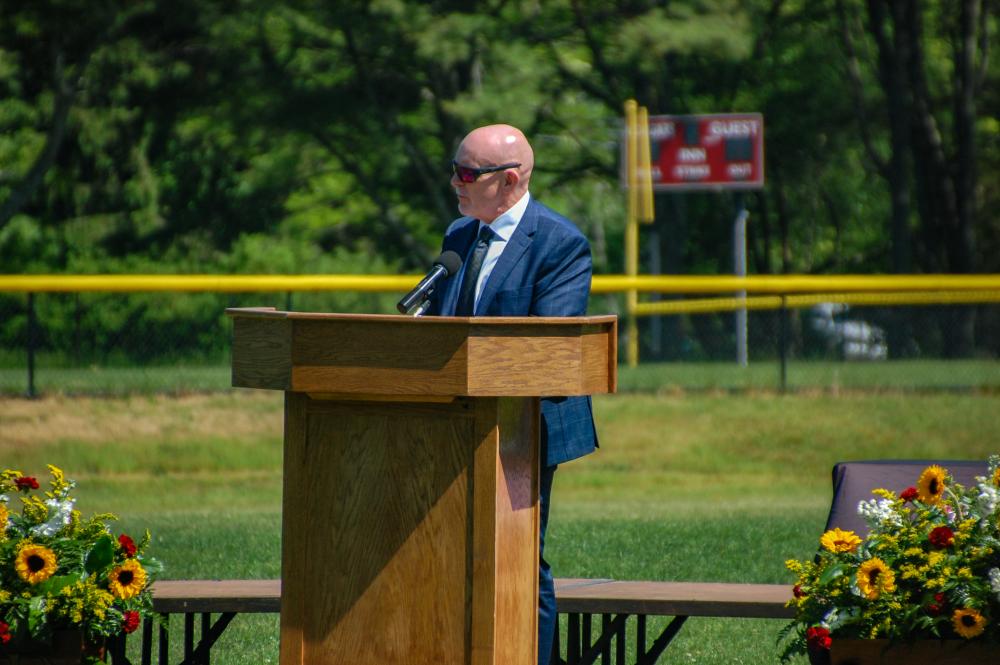 Gary Linehan, principal of Old Colony Regional Vocational Technical High School, speaks at a graduation. Photo by Grace Roche
Gary Linehan, principal of Old Colony Regional Vocational Technical High School, speaks at a graduation. Photo by Grace Roche
Gary Linehan, principal of Old Colony Regional Vocational Technical High School, speaks at a graduation. Photo by Grace Roche
High schoolers show up to school late for many reasons. Some can’t resist an early-morning coffee stop while some stay awake too late on their phone and don’t wake up in time. Others struggle with serious mental health issues or complicated family lives that make timeliness difficult.
Area public schools have taken different approaches to solving the problem, from strict rules and detentions at Old Rochester Regional High School to one-on-one checkins at Old Colony Regional Vocational Technical High School, to try to get students in their seats by the time the first bell rings.
School leaders around the South Coast all trace today’s tardiness habits back to the pandemic. Absenteeism spiked during the COVID-19 pandemic and, for many schools, it still hasn’t returned to 2010s levels. (area-specific pandemic reason)
Upper Cape Principal Josh Greeley said online education and more lenient rules led families and teachers to believe school is “not essential,” and the effects have lingered.
Many area schools stopped tracking tardies during the pandemic, often because of the difficulties managing remote classes. While attendance was tracked, most schools found it difficult to keep track of students logging into class late.
Tardiness data has become a crucial metric for teachers and principals, but varying definitions still means it’s not tracked statewide. However, tardiness across the South Coast has surged in recent years, according to records from local high schools.
Sippican Week collaborated with The New Bedford Light to understand how schools have used this data to address chronic absenteeism and tardiness since the pandemic.
Coming to school late sometimes is an early warning sign of a student’s disengagement, or maybe that they’re dealing with challenges outside of school. For classes in the early morning, tardiness can have the same effect on student learning as being absent.
Old Rochester principal Michael Devoll said getting to school on time is about sending the right message, and that a student is saying “I'm here and I'm ready to learn” when they’re on time.
“Those are the expectations that our teachers set forth,” Devoll said.
At Old Rochester, strict punitive measures have encouraged kids to get to school on time.
Every two tardies counts as an absence from class. For students who often arrive late for the first period, this can impact class credit and harm their ability to graduate on time. Chronically tardy students also receive Saturday detentions.
Devoll said this has particularly helped among older students, as most tardiness at Old Rochester is due to student drivers.
Administrators also reach out to families to determine if there are underlying reasons students are consistently arriving late.
“I always joke with my staff that we know that most families in the morning are pulling off minor miracles to all get out at the same time and on the road,” Devoll said. “If there's some type of pattern that we can identify and work with a family on, we'll do that.”
Meanwhile, vocational schools have seen some of the lowest rates of absenteeism and tardiness — but they’re still not immune.
Old Colony principal Gary Linehan said he sees two distinct groups of tardy students at his school.
For students who occasionally show up late with coffee in hand, he said a simple call home often fixes the problem. Progressive discipline, one-hour, two-hour and Saturday detentions depending on the number of tardies, also encourages timeliness.
Chronic tardiness, he said, is most common among students from low-income families or who struggle with their mental health. In these cases, administrators involve parents and counselors to find a solution.
"It's a complex issue because every kid's different,” Linehan said. “We try to be as consistent as we can with the policy, but we also try to be understanding of certain situations”
At Old Colony, this means finding the root cause of the tardiness and creating a plan to address it, usually including frequent check-ins with the adjustment counselor.
At Upper Cape, building connections with students and parents has been key to reducing tardiness each year.
Members of the school’s Student Council said their peers who are often tardy are the ones who aren’t connected to the school. Councilors said strong friendships, relationships with teachers, and involvement in extracurricular activities motivated them to show up on time. They said their peers who come to school late, if at all, tend to lack those connections.
Junior Penelope Heaslip said her teachers make her feel “supported at the school, even on my bad days.” Fellow junior Bria Pavlisko said she stays busy after class and “knowing that I have something after school to look forward to” helps keep her motivated.
Senior Ally Webb said classmates who aren’t involved in a club or sport are more likely to be tardy. “The kids that are really invested in the school and their commitments often are the ones that show up just because they have a reason to be here,” Webb said.
Other reasons council members gave for their peers’ tardiness include missing the bus and struggling to find alternative transportation, poor sleep habits that make it hard to wake up in the morning, and mental health struggles. Ivy Mesple, a junior, said she’s noticed how the seasons affect her timeliness, and she finds it harder to get up early during the winter.
Every week, a group of administrators, teachers and counselors meet to discuss attendance and tardiness data and look to identify why students arrive late.
Bad sleep habits, transportation concerns and family issues are among some of the more common reasons students show up after the first bell. Upper Cape Superintendent Roger Forget said some students who drive are also late because they stop for Dunkin on the way to class.
The school’s approach to reducing tardiness is two-pronged — a blend of punitive and supportive measures.
“Having a personal relationship and good communication with parents and students goes a long way,” Greeley said. “We really have boots on the ground with our students.”
This examination of tardiness at schools serving Tri-Town students is part of a larger collaboration with the New Bedford Light. The full collaboration is a two-part online series that explores the challenges local schools face in tracking and reducing tardiness, and what solutions are addressing the problem. To read part one, click here and for part two click here.