











Presentation explains donated voting devices at Rochester Select Board
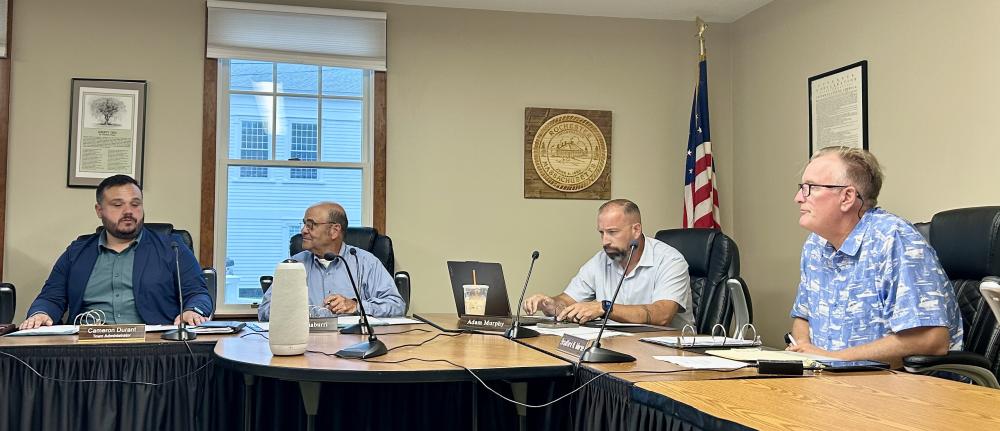 The Select Board at a meeting on Monday, Aug. 3. From left: Cameron Durant, Paul Ciaburri, Adam Murphy and Bradford Morse. Photo by Mari Huglin
The Select Board at a meeting on Monday, Aug. 3. From left: Cameron Durant, Paul Ciaburri, Adam Murphy and Bradford Morse. Photo by Mari Huglin
The Select Board at a meeting on Monday, Aug. 3. From left: Cameron Durant, Paul Ciaburri, Adam Murphy and Bradford Morse. Photo by Mari Huglin
ROCHESTER — Representatives from Meridia, a company that manufactures remote voting devices, met with Rochester leaders to address questions and concerns about their product.
An anonymous resident donated 400 remote voting devices to the town this spring for use at Town Meeting, but residents were concerned about how the devices would change voting on town matters and if tampering with the results is possible.
At a Monday, Aug. 3 Select Board meeting Town Administrator Cameron Durant invited the voting devices company Meridia to present and explain its product.
During the Select Board's Monday, Aug. 3 meeting, Meridia employees Sean McPeak and Peter Babel gave a presentation over Zoom call to answer questions and demonstrate use of the devices.
The devices operate on radio frequency that sends a signal to a receiver. The receiver is then connected to a computer with software to count the number of votes. The devices are not connected to the internet, and do not use WiFi or bluetooth. Residents will be able to vote from their seats completely anonymously, instead of the traditional method of raising a ballot slip.
“It is quite secure,” Babel said. “We've had zero instances at Town Meeting or even attempts of meddling.”
While the board originally planned to use the devices at Spring Town Meeting, it later decided to obtain training and more information before using them.
Babel clarified that the voting devices do not have to be used for every vote meaning voice votes can still be used.
Meridia has been making voting technology for 53 years. The company originally created devices for the U.S. House of Representatives.
Durant and McPeak said the devices were produced and directly mailed from Meridia to Rochester, so there was no possibility of the devices being tampered with. Babel said the devices do not influence the debate held at Town Meeting, since the devices are only used for the final vote.
He said Meridia will always be available to answer questions and host training about the devices as long as Rochester keeps them for.
Select Board Chair Paul Ciaburri supported keeping the devices for future use.
“It’s not better than what we’ve been doing,” Ciaburri said. “That was great for a lot of years but this is much more accurate and pretty good technology.”